


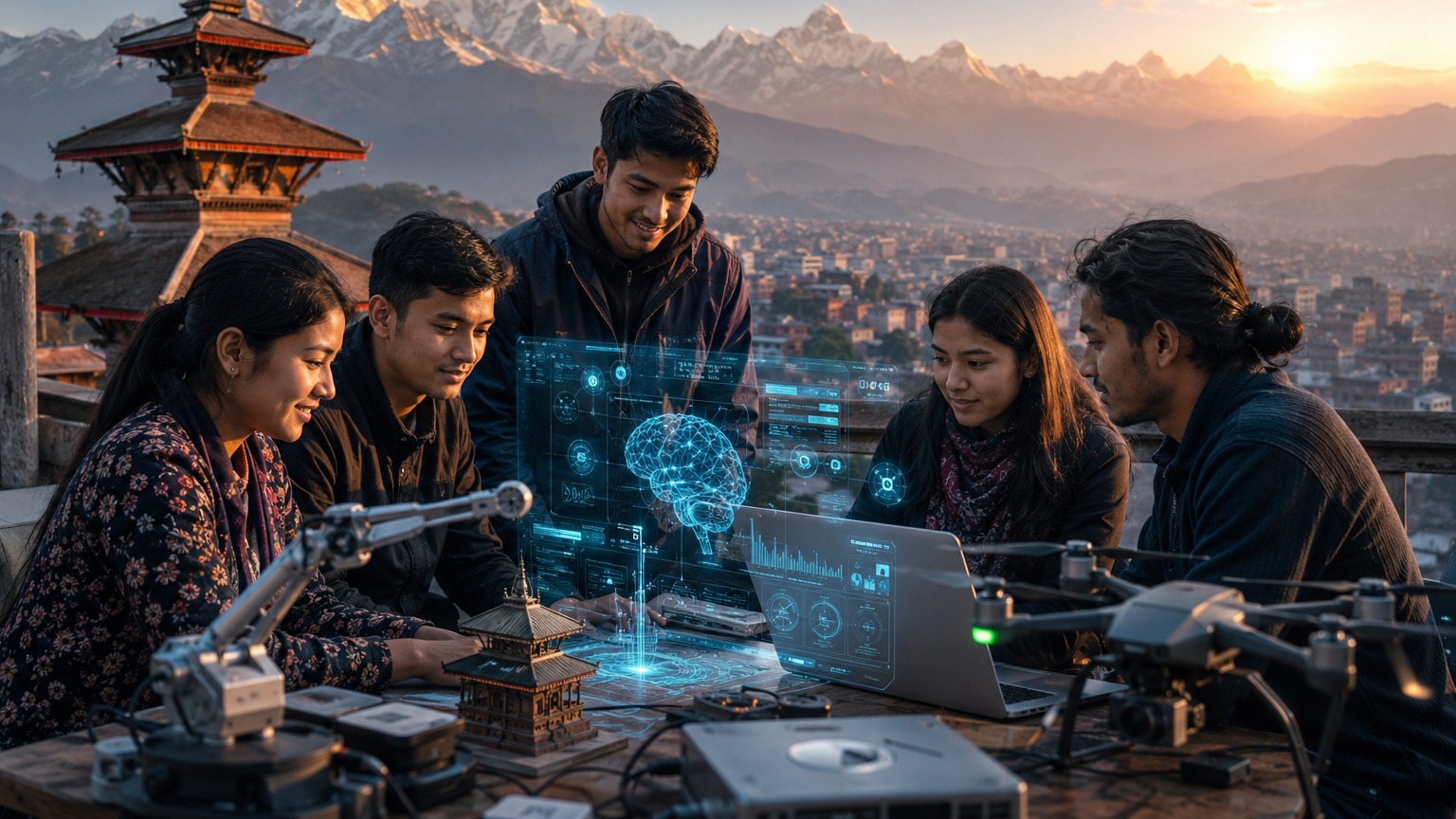
Artificial intelligence is no longer a distant technology for Nepal. In 2026, AI is beginning to change how people work, how students learn, how companies develop software, how government institutions operate and how information moves through Nepali society.
The shift has accelerated since Nepal approved its National AI Policy 2082 and established a National Artificial Intelligence Centre under the Ministry of Communication and Information Technology. The government’s wider digital-transformation agenda is also increasingly connecting artificial intelligence with economic development, public services, skills and employment.
But Nepal’s AI transition is not happening evenly.
Technology companies and skilled professionals are already using AI extensively, while schools, public institutions and smaller businesses are still working out how to use the technology safely and effectively. A 2026 academic study of 287 industries in Kathmandu Valley found that AI readiness remains limited and that technological, organisational and environmental factors strongly influence adoption.
The result is a country entering an AI-driven period with significant opportunities — but also major questions about jobs, education, privacy, skills, infrastructure, misinformation and who benefits from the technology.
Key Facts
- Nepal approved its National AI Policy 2082 in 2025.
- The government established the National AI Centre in November 2025.
- Nepal’s 2026 government agenda places technology, digital transformation and IT-driven employment among its priorities.
- Nepalese software companies are already using generative AI and AI coding tools in everyday work.
- AI is entering education, while teachers and students are already using generative AI tools.
- Kathmandu University researchers are developing AI-enabled language technology involving Nepali, Tamang and English.
- Nepal’s courts have approved AI for selected legal research and administrative functions while retaining human responsibility for judicial decisions.
- Government agencies are exploring AI, drones and satellite technology for environmental monitoring and forest-fire risk management.
- AI-generated misinformation has become a real problem during major disasters, including the 2026 Bhotekoshi floods.
Table of Contents
- What is happening with AI in Nepal?
- Why 2026 is an important year
- How AI is changing Nepalese workplaces
- AI and jobs in Nepal
- AI and education
- AI and government
- AI and Nepal’s legal system
- AI and business
- AI and language
- AI and agriculture
- AI and the environment
- AI and media and misinformation
- Nepal’s AI policy
- What are the biggest challenges?
- What opportunities could AI create?
- What happens next?
What Is Happening With AI in Nepal?
The most important change is that AI is moving from discussion to implementation.
For several years, artificial intelligence in Nepal was primarily associated with universities, software companies, technology enthusiasts and startups. That is changing.
The government has created a national policy framework and a National AI Centre. Businesses are integrating AI into software development and operational work. Educational organisations are discussing responsible AI use. Researchers are developing local-language systems. Government institutions are considering AI for public administration and environmental monitoring.
This does not mean Nepal has become an AI-first economy.
It means AI is increasingly becoming part of the country’s digital infrastructure and economic conversation.
Why Is 2026 an Important Year for AI in Nepal?
Three developments make 2026 particularly important.
First, Nepal has moved from policy discussion to institutional implementation
The National AI Policy 2082 created a national framework for AI development and governance. The establishment of the National AI Centre gave that policy an institutional mechanism.
Second, businesses are already adopting AI
Nepal’s technology sector is using generative AI and AI-assisted software-development tools to increase productivity.
The Kathmandu Post reported that Nepalese software companies were retraining workers and changing hiring expectations as AI became integrated into development and operational processes.
Third, AI is spreading beyond the technology sector
AI is now appearing in discussions about education, courts, agriculture, forests, language preservation, public administration and media.
That broader spread is what makes the 2026 AI story important for the whole country.
How AI Is Changing Nepalese Workplaces
The workplace may be one of the first places where ordinary Nepalis feel the impact of AI.
Software developers are using AI assistants for coding, documentation, research and other development tasks. Nepal Telecom engineers, for example, have used AI-assisted development approaches to build digital systems and portals.
The effect is not simply that AI is replacing programmers.
Instead, the nature of the work is changing.
Workers increasingly need to:
- understand AI-generated output;
- identify errors;
- verify information;
- write better instructions for AI systems;
- integrate AI into existing workflows;
- protect sensitive data;
- understand cybersecurity risks;
- combine technical skills with human judgment.
That creates a different kind of labour-market pressure.
The valuable worker of the future may not simply be the person who knows how to perform a task manually. It may be the person who knows how to use AI to perform the task while checking whether the result is correct.
Is AI Replacing Jobs in Nepal?
There is no evidence that AI has suddenly replaced large numbers of Nepalese workers across the economy.
However, there is evidence that AI is changing the skills employers want.
The Kathmandu Post reported that Nepalese software companies were increasingly looking for workers who could verify AI output and work with data, while demand for some traditional programming capabilities was changing.
At the same time, AI-related employment opportunities are appearing.
Current job listings in Nepal include positions such as:
- machine-learning engineer;
- applied-AI software engineer;
- AI product operator;
- AI technical leadership roles;
- data engineering roles;
- AI training roles;
- AI-related specialist positions.
This suggests that the immediate impact of AI on Nepal’s labour market is likely to be more complicated than simple job destruction.
Some tasks will become automated.
Some existing jobs will change.
New roles will emerge.
And workers without AI-related skills may face increasing pressure to retrain.
AI and Education in Nepal
Education is another area where the change is already visible.
Students have access to generative AI systems capable of explaining concepts, summarising information, translating text, generating ideas and assisting with assignments.
Teachers are also experimenting with these tools.
The challenge is that access to AI is moving faster than the development of consistent educational rules and training.
The British Council’s Ai4Ed Nepal initiative has focused on responsible and effective use of AI in basic education, including teacher-led research and mentorship.
UNESCO has also worked with Nepalese education stakeholders on integrating AI into education policy, identifying issues including data quality, user competency, ethics, accessibility and digital inequality.
The central question for Nepal’s schools and universities is therefore not simply:
Should students use AI?
It is:
How should students and teachers use AI without weakening learning, critical thinking and academic integrity?
That distinction will become increasingly important.
AI and Government Services
Nepal’s government is also connecting artificial intelligence with digital governance.
The National AI Centre was established to support the implementation of the country’s AI policy and help develop AI-related programmes.
The government has also continued broader digital-government reforms, including expansion of citizen-facing digital services and work on AI-related legislation.
The potential benefits are significant.
AI could help government agencies:
- process documents;
- answer routine public questions;
- analyse large datasets;
- identify administrative bottlenecks;
- support translation;
- improve information retrieval;
- automate repetitive administrative work;
- improve disaster information systems.
But public-sector AI also creates risks.
Government AI systems can affect people’s access to services, information and rights. That makes transparency, data protection and human oversight particularly important.
AI Is Entering Nepal’s Legal System
One of the clearest examples of AI moving into public institutions came from Nepal’s judiciary.
In July 2026, the Supreme Court approved a policy allowing AI to support legal research, case management and administrative tasks.
At the same time, the policy prevents AI from taking over functions requiring judicial discretion, including writing judgments and making judicial decisions.
That approach illustrates an important principle for Nepal:
AI can assist institutions without necessarily replacing human responsibility.
The distinction between assistance and decision-making will become increasingly important as AI expands into government.
AI and Nepalese Business
Businesses are another major area of change.
AI can potentially help Nepalese companies automate repetitive tasks, analyse customer information, generate content, support software development and improve internal decision-making.
Research on Nepal’s business environment has already identified emerging AI applications in sectors including banking, insurance, tourism and hydropower.
The opportunity is particularly important for Nepal because the country has a relatively small domestic market but a growing technology and outsourcing sector.
AI could allow Nepalese companies to deliver more sophisticated services internationally without requiring the same increase in headcount.
But that opportunity depends on skills, infrastructure, access to computing resources and the ability of companies to adopt AI responsibly.
AI and Nepal’s Languages
Perhaps one of the most important long-term AI opportunities for Nepal is language technology.
Nepal is linguistically diverse, and many languages have limited digital representation.
Kathmandu University’s Information and Language Processing Research Lab has been working on language technologies, including a trilingual system covering Nepali, Tamang and English. Researchers are also using technology to digitise and preserve linguistic and cultural materials.
AI could eventually make it easier to:
- translate between Nepali languages;
- digitise historical documents;
- develop speech-recognition systems;
- create educational resources;
- preserve endangered languages;
- improve accessibility;
- make government information available in more languages.
This is an area where Nepal does not simply have to copy larger countries.
Its linguistic diversity could become a reason to develop specialised AI systems.
AI and Agriculture
Agriculture remains an important part of Nepal’s economy and rural livelihoods.
AI could support agriculture through:
- crop disease detection;
- weather analysis;
- irrigation planning;
- soil analysis;
- agricultural advice;
- satellite monitoring;
- supply-chain forecasting.
Research published in 2026 highlights the potential of AI in Nepalese agribusiness but also identifies major barriers, including infrastructure limitations, costs, data scarcity, low digital literacy and localisation challenges.
That means AI adoption in rural Nepal will not happen simply because the technology exists.
Connectivity, affordability and local-language interfaces will determine who actually benefits.
AI and Nepal’s Environment
Environmental management is another emerging use case.
In August 2026, Nepal’s Ministry of Agriculture, Forest and Environment discussed using drones, artificial intelligence and digital tracking systems for forest management.
The ministry also explored AI and satellite technology for forest-fire monitoring, early-warning systems and risk mapping.
This illustrates how AI could be particularly valuable in Nepal’s difficult geography.
Nepal’s mountains, forests and remote settlements can make conventional monitoring expensive and slow.
AI combined with satellite imagery, drones and sensor networks could help authorities monitor large areas more efficiently.
AI, Media and Misinformation
The biggest downside of AI may not be job losses.
It may be trust.
Nepal experienced this problem during the 2026 Bhotekoshi disaster.
AI-generated videos, recycled footage and misleading content spread online after the floods. Authorities subsequently asked social-media platforms to remove AI-generated videos, fraudulent QR codes and misleading posts.
This creates a serious challenge for journalists and the public.
When realistic images and videos can be generated quickly, people cannot assume that something is genuine simply because it looks authentic.
Nepal’s communications minister has also stressed the importance of factual journalism and editorial responsibility as AI-generated content and deepfakes become more common.
For Nepal Monitor, this creates an important editorial principle:
AI should make journalism more useful, not less trustworthy.
What Is Nepal’s National AI Policy?
Nepal’s National AI Policy 2082 is the country’s central policy framework for artificial intelligence.
The Ministry of Communication and Information Technology officially lists the policy among its national policies.
The policy is intended to provide a framework for responsible AI development and adoption while supporting economic and social development.
Its importance extends beyond technology companies.
It establishes AI as a national development issue involving:
- government;
- education;
- research;
- business;
- skills;
- infrastructure;
- data;
- regulation;
- ethics.
The real test, however, is implementation.
A policy can establish goals. Turning those goals into functioning institutions, infrastructure, skills and services is considerably harder.
What Are the Biggest AI Challenges for Nepal?
1. Skills
Nepal needs more people with advanced AI, data, software and cybersecurity skills.
2. Infrastructure
AI requires computing resources, reliable connectivity, data infrastructure and electricity.
3. Data
AI systems depend heavily on high-quality data. Nepal also needs stronger approaches to privacy, security and data governance.
4. Language localisation
Global AI models do not automatically work equally well for every Nepali language and context.
5. Digital inequality
People in Kathmandu and major technology centres may gain access to AI much earlier than people in remote or underserved communities.
6. Misinformation
Generative AI makes fake images, videos, voices and text easier to create.
7. Job disruption
Workers whose roles contain repetitive tasks may need to develop new skills.
8. Governance
Government institutions need rules for when AI can make recommendations, when humans must intervene and how citizens can challenge automated decisions.
What Opportunities Could AI Create for Nepal?
AI could create opportunities in several areas.
| Area | Potential opportunity |
|---|---|
| IT services | Higher-value exports |
| Education | Personalised learning and teacher support |
| Agriculture | Crop and farm intelligence |
| Tourism | Translation and visitor services |
| Healthcare | Administrative and diagnostic support |
| Government | Faster public services |
| Environment | Monitoring and early warning |
| Languages | Translation and preservation |
| Finance | Fraud detection and automation |
| Startups | New AI products |
| Freelancing | International AI-enabled services |
| Research | Local AI models and datasets |
Nepal’s government has also positioned AI and IT as potential areas for investment and employment. In August 2026, Finance Minister Swarnim Wagle encouraged overseas Nepalis to explore investment in sectors including IT and AI.
What Happens Next?
The next stage of Nepal’s AI development will be less about whether AI exists and more about whether Nepal can build the conditions required to use it effectively.
The country needs:
- stronger AI skills;
- better digital infrastructure;
- high-quality local datasets;
- responsible AI governance;
- stronger cybersecurity;
- local-language AI systems;
- university-industry cooperation;
- startup financing;
- responsible adoption by government;
- better digital literacy.
The government’s own policy framework has created a starting point.
The challenge now is execution.
The Bottom Line
AI is changing Nepal in 2026, but not in one dramatic transformation.
The change is happening through thousands of smaller shifts.
A software engineer writes code with an AI assistant.
A student uses generative AI to learn.
A teacher experiments with AI in the classroom.
Researchers develop tools for Nepali and Tamang.
Government institutions begin testing AI-supported services.
Courts use AI for selected administrative and research tasks.
Environmental authorities explore AI for forest monitoring.
Businesses investigate automation.
And at the same time, journalists and authorities face a new problem: increasingly convincing misinformation.
That makes Nepal’s AI story bigger than technology.
It is becoming a story about jobs, education, business, government, culture, language, public trust and the country’s economic future.
Nepal has already taken the first institutional steps.
The question for the years ahead is whether those steps can turn AI from a policy ambition into technology that genuinely improves life across the country.
KEY TAKEAWAYS
Key takeaway 1
Nepal has moved beyond simply discussing AI.
The National AI Policy and National AI Centre provide an institutional foundation.
Key takeaway 2
AI is already affecting Nepalese workplaces.
Software companies are changing workflows, hiring expectations and employee skills.
Key takeaway 3
Education is becoming a major AI battleground.
Students and teachers are already using generative AI while institutions develop responsible-use frameworks.
Key takeaway 4
Local-language AI could be strategically important.
Nepalese researchers are developing systems involving Nepali and other local languages.
Key takeaway 5
AI can help with difficult geographical problems.
Environmental agencies are exploring AI, satellite imagery and drones for forest monitoring and early warning.
Key takeaway 6
AI also creates serious information risks.
The 2026 floods demonstrated how AI-generated misinformation can complicate disaster communication.
FAQ
1. What is AI in Nepal?
AI in Nepal refers to the development and use of artificial intelligence technologies by Nepalese businesses, government agencies, universities, startups and individuals. In 2026, applications are emerging across workplaces, education, government, software, language technology, agriculture and environmental management.
2. How is AI changing Nepal in 2026?
AI is changing Nepal through workplace automation, software development, education, government services, language technology, business operations, environmental monitoring and information distribution. Adoption remains uneven because of skills, infrastructure, data and governance challenges.
3. What is Nepal’s National AI Policy?
Nepal’s National AI Policy 2082 is the government’s national framework for artificial intelligence development and governance. It aims to support responsible AI development while connecting the technology with economic and social development.
4. Does Nepal have a National AI Centre?
Yes. Nepal established a National Artificial Intelligence Centre under the Ministry of Communication and Information Technology in 2025 to support implementation of the country’s AI policy.
5. Are there AI jobs in Nepal?
Yes. AI-related positions are appearing in software engineering, machine learning, data engineering, AI operations, AI training and related fields. Current job listings show active demand for AI-related skills in Nepal.
6. Is AI replacing jobs in Nepal?
AI is changing job tasks and the skills employers want, particularly in technology. However, there is not enough evidence to say that AI is broadly replacing Nepalese workers across the economy. The more immediate trend is job redesign, automation and increasing demand for AI-related skills.
7. How is AI being used in Nepalese education?
Students and teachers are using generative AI tools, while organisations including UNESCO and the British Council are working on responsible AI integration in education.
8. Can AI help preserve Nepal’s languages?
Yes. Researchers in Nepal are already using AI and language technologies to digitise and preserve linguistic resources. Kathmandu University researchers have developed a trilingual translation system involving Nepali, Tamang and English.
9. What are the biggest AI challenges for Nepal?
Major challenges include skills shortages, infrastructure, data availability, digital inequality, privacy, cybersecurity, misinformation and the need for effective AI governance.
10. What is the future of AI in Nepal?
The future will likely depend on whether Nepal can turn its AI policy into practical infrastructure, skills, research, businesses and public services. Local-language technology, IT exports, education, agriculture, government services and environmental monitoring are promising areas.