


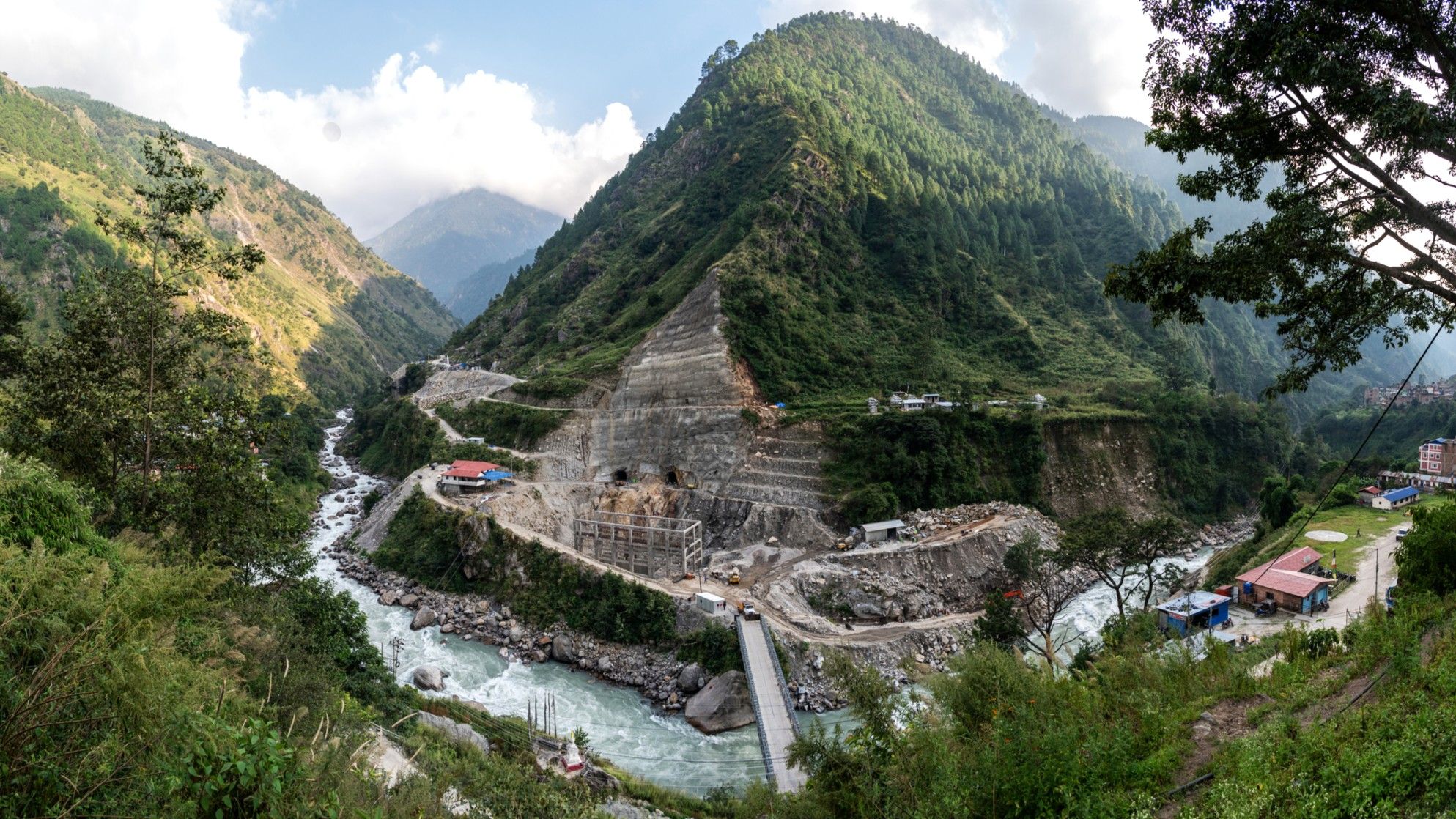
Nepal’s economy enters the second half of 2026 with a mixture of stronger external finances, modest economic growth, large remittance inflows and major investment needs. But the picture has changed sharply since the August Bhotekoshi disaster, which damaged hydropower, roads, businesses and other infrastructure.
The government estimates that NPR 723.31 billion will be required for recovery and reconstruction in the flood-hit areas, with infrastructure accounting for roughly three-quarters of the total requirement.
At the same time, Nepal Rastra Bank’s latest annual data show remittances of NPR 2.363 trillion in FY2025/26, while the balance of payments recorded a surplus of NPR 1.027 trillion.
The result is a complicated economic picture: Nepal has significant financial buffers, but it also needs to turn those buffers and investment flows into productive domestic activity, infrastructure and jobs.
Key Facts
| Indicator | Latest available figure |
|---|---|
| FY2025/26 remittances | NPR 2.363 trillion |
| Worker remittances as share of GDP | 35.8% |
| FY2025/26 BOP surplus | NPR 1.027 trillion |
| FY2025/26 annual-average inflation | 3.08% |
| FY2025/26 tourist arrivals | About 1.158 million |
| FY2026/27 government budget | NPR 2.124 trillion |
| Bhotekoshi recovery requirement | NPR 723.31 billion |
| Bhotekoshi infrastructure requirement | NPR 473.57 billion |
| Bhotekoshi energy recovery requirement | NPR 390.62 billion |
| Hydropower projects affected | 13 projects / 783 MW |
The figures come from Nepal Rastra Bank, the Government of Nepal and reported government damage assessments.
What Is Driving Nepal’s Economy in 2026?
There is no single engine behind Nepal’s economy.
The major forces are:
- Remittances from Nepali workers abroad
- Tourism
- Hydropower and electricity
- Government spending and reconstruction
- Private-sector investment
- Trade and consumption
- Digital and technology-related activity
The relative importance of these drivers is changing.
Remittances currently provide an especially large external and household-income support, while hydropower and reconstruction could become increasingly important sources of investment and economic activity.
Is Nepal’s Economy Growing in 2026?
Yes, but growth forecasts depend on the fiscal year and institution being considered.
The IMF’s June 2026 assessment estimated real GDP growth at 3.0% for FY2025/26 and projected 4.6% for FY2026/27.
The Asian Development Bank’s July 2026 outlook, using its own forecast framework, puts Nepal’s GDP growth at 3.9% in 2026 and 4.5% in 2027.
These numbers should not be treated as exact measurements of the same period. Forecasts are updated at different times and may use different fiscal-year or calendar-year presentations.
The broader message is that Nepal is expected to continue growing, but growth remains below the level required to transform the country’s employment and productivity structure rapidly.
Why Are Remittances So Important to Nepal?
Remittances have become one of the most important pillars of Nepal’s economy.
Nepal Rastra Bank reported NPR 2.363 trillion in remittance inflows during FY2025/26, equivalent to 35.8% of GDP.
Remittances support the economy in several ways:
- household consumption;
- education spending;
- housing;
- imports;
- financial-sector deposits;
- foreign-exchange availability;
- debt repayment;
- household investment.
But remittances also reveal one of Nepal’s structural challenges.
A large proportion of working-age Nepalis continue to seek employment abroad. That means foreign employment supports household incomes while simultaneously highlighting the difficulty of creating enough productive employment inside Nepal.
Are Remittances the Same as Job Creation?
No.
Remittances can strengthen household finances and Nepal’s external position without necessarily creating a comparable number of domestic jobs.
This distinction matters for the country’s long-term economic strategy.
A sustainable employment-led expansion would require more productive activity inside Nepal, particularly in areas such as:
- manufacturing;
- tourism;
- hydropower;
- construction;
- information technology;
- agriculture and agribusiness;
- logistics;
- digital services.
The World Bank has identified private-sector-led growth, improved infrastructure, private finance, tourism, IT and agribusiness as important areas for strengthening resilience and creating jobs.
What Is Happening With Investment in Nepal?
Nepal’s investment story is mixed.
The government has made investment and private-sector development important elements of its FY2026/27 economic programme. The budget totals NPR 2.124 trillion, including approximately NPR 431.1 billion in capital expenditure.
The IMF also expects investment to strengthen as uncertainty declines and economic activity recovers. Its June assessment projected gross investment at 40.5% of GDP in FY2026/27, compared with 34.9% in FY2025/26.
However, the ability to convert budget allocations and investment plans into completed projects remains critical.
For Nepal, the difference between announced investment and implemented investment is economically significant.
Why Hydropower Matters
Hydropower is one of Nepal’s biggest long-term economic opportunities.
It can support:
- domestic electricity consumption;
- industrial development;
- electricity exports;
- foreign-exchange earnings;
- infrastructure investment;
- employment;
- data centres and digital infrastructure.
But the August 2026 disaster demonstrated the vulnerability of energy infrastructure.
The government assessment identified damage to 13 hydropower projects with a combined capacity of 783 MW and five solar projects with a combined capacity of 24 MW. The estimated recovery and reconstruction requirement for the energy sector and grid systems is NPR 390.62 billion.
India has since approved electricity imports of up to 654 MW for 18 hours per day through December 31, 2026, following the disruption to Nepal’s electricity infrastructure.
This illustrates both the importance of hydropower to Nepal’s economy and the need for infrastructure resilience.
How Big Is the Economic Impact of the Bhotekoshi Disaster?
The impact is substantial.
A rapid government assessment estimates that Nepal requires NPR 723.31 billion for recovery and reconstruction following the August 26 floods.
Infrastructure accounts for approximately NPR 473.57 billion, or about 75% of the total requirement.
A preliminary assessment reported total damage and economic losses of approximately NPR 408 billion across five districts, with nearly 4,800 businesses and 7,570 homes damaged.
The disaster therefore affects the economic outlook in two directions.
In the short term, destroyed infrastructure, disrupted electricity generation and damaged businesses can reduce economic activity.
In the reconstruction phase, however, rebuilding roads, bridges, power infrastructure, homes and businesses can create demand for construction, engineering, materials, transport and financial services.
That does not mean reconstruction automatically produces higher living standards. Its economic benefit depends on how quickly projects are funded, how efficiently they are implemented and whether rebuilt infrastructure is more resilient.
Could Reconstruction Create Jobs?
Potentially, yes.
Reconstruction can create employment in:
- construction;
- civil engineering;
- transport;
- electrical work;
- equipment supply;
- building materials;
- logistics;
- professional services;
- financial services.
But the scale and duration of those jobs will depend on the actual flow of reconstruction funding.
The government’s estimated requirement is not the same thing as money already spent.
This distinction is important when assessing the economic outlook.
What Role Does Tourism Play?
Tourism remains an important source of economic activity and foreign exchange.
Nepal recorded approximately 1.158 million tourist arrivals during FY2025/26, while travel income increased to about NPR 90.05 billion.
Tourism also creates employment beyond hotels and airlines.
Its economic footprint includes:
- trekking;
- mountaineering;
- guides;
- restaurants;
- transport;
- retail;
- handicrafts;
- accommodation;
- domestic aviation;
- local services.
Kathmandu, Pokhara, Everest, Annapurna, Chitwan, Lumbini and Mustang therefore remain important components of Nepal’s economic story.
However, tourism is sensitive to infrastructure disruptions, international travel conditions and perceptions of safety.
What Does Nepal’s 2026 Budget Mean for Growth?
The FY2026/27 budget totals NPR 2.124 trillion.
The government allocated approximately:
- NPR 1.271 trillion for recurrent expenditure;
- NPR 431.1 billion for capital expenditure;
- NPR 422.64 billion for financial management.
The financing gap is approximately NPR 657.29 billion, including domestic and foreign borrowing.
The budget’s stated economic priorities include investment, employment, infrastructure, technology and private-sector development.
The important question for the economy is therefore not simply how large the budget is.
It is whether capital allocations become completed infrastructure and productive economic activity.
Can Technology Create New Jobs in Nepal?
Technology is increasingly part of Nepal’s economic strategy.
The FY2026/27 policy programme places emphasis on digitalisation and technology-driven employment, while the government has discussed measures designed to expand Nepal’s digital economy and create opportunities for remote work.
This could create opportunities in:
- software development;
- AI services;
- business-process outsourcing;
- digital finance;
- cybersecurity;
- data services;
- remote professional work;
- technology startups.
Nepal Monitor’s existing research also indicates that AI’s effect on Nepal’s labour market is likely to be different from that of richer economies because Nepal has a different occupational structure.
The bigger economic question is whether technology allows Nepalese firms to sell more high-value services internationally without requiring workers to leave the country.
What Are the Biggest Risks to Nepal’s Economy?
Several risks remain.
1. Disaster and climate risk
The Bhotekoshi disaster has demonstrated the potential economic cost of extreme events.
2. Weak domestic job creation
Remittances remain exceptionally important, but the economy needs stronger domestic employment opportunities.
3. Private investment
Investment decisions can remain sensitive to political, regulatory and economic uncertainty.
4. Infrastructure execution
Large allocations do not automatically translate into completed infrastructure.
5. External shocks
Nepal remains exposed to international energy prices, tourism conditions and economic conditions in countries where Nepalis work.
6. Import dependence
A widening trade deficit can increase pressure on the external sector even when remittances remain strong.
The IMF expects Nepal’s trade deficit to widen substantially as imports increase, including imports associated with reconstruction and hydropower projects.
What Happens Next for Nepal’s Economy?
The next stage of Nepal’s economic story will depend on whether the country can convert financial stability into productive investment.
Three developments deserve particular attention.
Reconstruction
The government needs to turn the Bhotekoshi damage assessment into funded and implemented reconstruction projects.
Investment
Nepal needs private and public investment to move from announcements to completed projects.
Employment
The long-term test will be whether investment generates productive jobs inside Nepal rather than continuing to rely heavily on foreign employment and remittances.
The Bottom Line
Nepal’s economy in 2026 is neither simply a growth story nor simply a crisis story.
The country has substantial foreign-exchange and remittance buffers, continued tourism activity, expanding hydropower potential and a large public investment programme.
At the same time, domestic job creation, private investment, infrastructure execution and disaster resilience remain major challenges.
The Bhotekoshi disaster has added another test. With reconstruction needs estimated at more than NPR 723 billion, the rebuilding process itself could become an important part of Nepal’s economic activity over the coming years.
The key question is whether Nepal can turn that reconstruction, along with hydropower, tourism, technology and private investment, into sustained productivity and employment rather than another cycle of temporary spending.
Takeaways
Key facts
- Nepal’s FY2025/26 remittances reached NPR 2.363 trillion.
- Remittances equalled 35.8% of GDP.
- FY2025/26 BOP surplus reached NPR 1.027 trillion.
- FY2026/27 budget: NPR 2.124 trillion.
- Government Bhotekoshi reconstruction requirement: NPR 723.31 billion.
- Infrastructure requirement: NPR 473.57 billion.
- Energy/grid recovery requirement: NPR 390.62 billion.
- 13 hydropower projects totalling 783 MW were identified as damaged.
Key takeaways
- Remittances remain central to Nepal’s economic stability.
- Growth is expected to continue but remains moderate.
- Hydropower remains a major long-term opportunity.
- Tourism remains an important source of activity and foreign exchange.
- Reconstruction has become a major economic variable.
- Domestic job creation remains a central challenge.
- The ability to execute investment will matter as much as announced spending.
FAQ
What is the state of Nepal’s economy in 2026?
Nepal’s economy is growing, but at a moderate pace. Remittances, tourism, hydropower, government spending and improving external financial buffers are supporting activity, while domestic job creation, private investment and infrastructure execution remain challenges.
What is Nepal’s GDP growth in 2026?
Forecasts vary according to the institution and period measured. The IMF projected 3.0% real GDP growth for FY2025/26 and 4.6% for FY2026/27, while the ADB’s July 2026 outlook forecasts 3.9% growth in 2026 and 4.5% in 2027.
What is driving Nepal’s economy?
Major drivers include remittances, tourism, hydropower, government expenditure, private investment, construction and services.
How important are remittances to Nepal?
Extremely important. Nepal Rastra Bank recorded NPR 2.363 trillion in remittance inflows in FY2025/26, equal to 35.8% of GDP.
Can Nepal create more jobs at home?
Potentially. Tourism, hydropower, construction, manufacturing, IT, digital services and agribusiness all have employment potential. The challenge is converting investment and economic activity into sustained domestic employment.
How will the Bhotekoshi disaster affect Nepal’s economy?
The disaster damaged infrastructure and businesses and created a large reconstruction requirement. The government estimates NPR 723.31 billion will be needed for recovery and reconstruction.
Is hydropower important to Nepal’s future economy?
Yes. Hydropower can support domestic industry, electricity exports, foreign-exchange earnings and investment. However, the recent disaster also demonstrated the need for stronger infrastructure resilience.
Is tourism important to Nepal’s economy?
Yes. Nepal recorded approximately 1.158 million tourist arrivals in FY2025/26, while travel income reached approximately NPR 90.05 billion.
What are Nepal’s biggest economic risks?
Key risks include natural disasters, weak domestic job creation, slow investment execution, external shocks, import dependence and uncertainty affecting private investment.
Could reconstruction boost Nepal’s economy?
Reconstruction can generate demand for construction, engineering, transport, materials and services. However, its eventual economic impact will depend on funding, implementation speed and the quality and resilience of rebuilt infrastructure.