


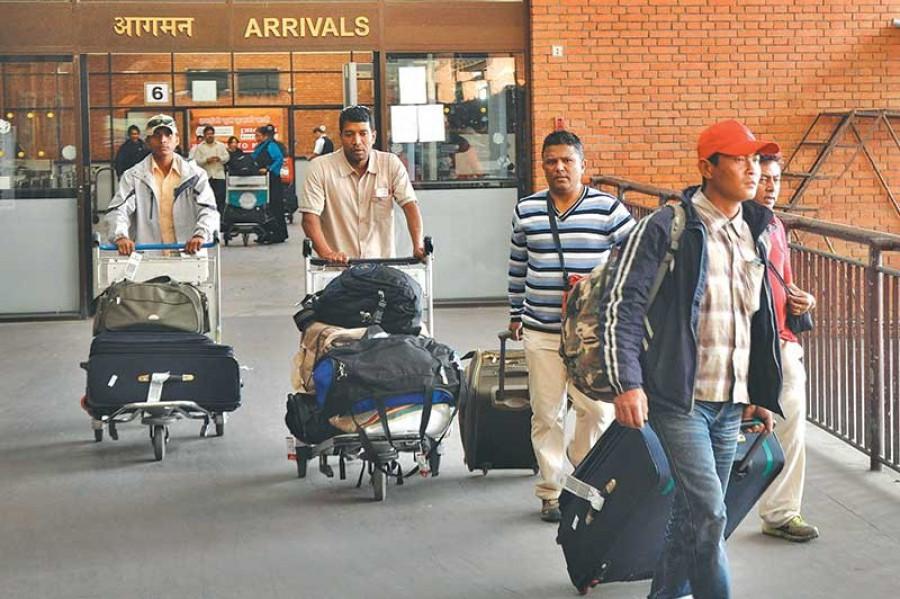
Nepal’s remittance economy is entering a new phase in 2026. Money sent home by Nepalis working abroad remains exceptionally strong, but the number of people receiving new approvals to leave for foreign employment has begun to weaken.
Nepal Rastra Bank recorded NPR 2.363 trillion in remittance inflows during FY2025/26, an increase of 37.1% from the previous year. Remittances were equivalent to 35.8% of Nepal’s GDP.
The momentum continued into the new fiscal year. In the first month of FY2026/27, Nepal received NPR 215.05 billion, up 21.2% year-on-year.
At the same time, 42,693 Nepalis received new final labour approvals for foreign employment in that first month, compared with 44,466 during the same period a year earlier.
The numbers point to an important question: why are remittances remaining so strong when fewer workers are newly leaving Nepal?
The answer is that remittance flows reflect the earnings of an already large overseas workforce, not simply the number of people leaving the country in a particular month.
Key Facts
| Indicator | Latest figure |
|---|---|
| FY2025/26 remittances | NPR 2.363 trillion |
| FY2025/26 remittance growth | 37.1% |
| Remittances as share of GDP | 35.8% |
| FY2025/26 remittances in US dollars | US$16.19 billion |
| FY2026/27 first-month remittances | NPR 215.05 billion |
| First-month annual growth | 21.2% |
| First-month remittances in US dollars | US$1.40 billion |
| New final labour approvals, first month | 42,693 |
| Re-entry labour approvals, first month | 27,748 |
Table of Contents
- What happened to Nepal’s remittances in 2026?
- Why are remittances still rising?
- Why can remittances rise while new migration falls?
- How important are remittances to Nepal’s economy?
- How do remittances support foreign exchange reserves?
- Why does Nepal remain dependent on migrant workers?
- What role does the Gulf play?
- What are the risks to Nepal’s remittance economy?
- Could remittance dependence become a long-term problem?
- What happens next?
What Happened to Nepal’s Remittances in 2026?
Nepal’s remittance inflows reached a record level in FY2025/26.
According to Nepal Rastra Bank, remittances increased 37.1% to NPR 2.363 trillion. In US-dollar terms, the increase was 28.1%, taking annual inflows to about US$16.19 billion.
The central bank’s data also show how large remittances have become relative to the domestic economy. Worker remittances were equivalent to 35.8% of GDP in FY2025/26.
The trend continued after the start of FY2026/27.
During the first month, covering mid-July to mid-August 2026, remittance inflows reached NPR 215.05 billion. That represented a 21.2% increase from the same period a year earlier.
In dollar terms, the increase was smaller, at 10.2%, with inflows reaching about US$1.40 billion.
The difference between the rupee and dollar growth rates matters because exchange-rate movements can affect the value of remittances measured in Nepalese rupees.
Why Are Remittances Still Rising?
Several factors help explain the strength of Nepal’s remittance inflows.
1. Nepal already has a very large overseas workforce
Remittance income does not depend only on how many workers leave Nepal this month.
Workers who migrated in earlier years continue to earn wages and send money home.
That creates a lag between migration statistics and remittance statistics.
A fall in new labour approvals therefore does not automatically produce an immediate fall in remittance inflows.
2. Existing workers can send more money
The amount sent by each migrant worker can change even when the number of workers does not.
Changes in wages, working hours, employment conditions, exchange rates and household needs can all affect the amount transferred to Nepal.
This is one reason remittance growth and migration growth should not be treated as identical indicators.
3. Re-entry migration remains significant
Nepal’s latest data show a distinction between new workers and workers returning to foreign employment.
In the first month of FY2026/27, 42,693 Nepalis received new final labour approval while 27,748 obtained re-entry approval.
The re-entry figure indicates that part of Nepal’s migration system consists of workers returning to overseas employment rather than first-time migrants.
4. Formal channels are becoming more important
Nepal has continued to expand formal and digital channels for cross-border money transfers.
Digital financial services, banking networks and wallet-based services can make it easier for migrant workers to transfer money to households.
The expansion of formal channels is also relevant to financial inclusion and the measurement of remittance flows.
5. Destination diversification matters
The World Bank has noted that Nepal’s remittance resilience has also been supported by diversification toward higher-wage destinations such as Europe and Japan.
This does not mean Nepal has stopped depending on traditional destinations.
Rather, the overseas employment system is becoming more geographically diverse while the Gulf remains highly important.
Why Can Remittances Rise While New Migration Falls?
This is the central point in Nepal’s 2026 remittance story.
Migration approvals measure the movement of workers. Remittances measure money sent by workers already earning abroad.
They therefore capture different parts of the same economic system.
A worker who left Nepal several years ago can continue sending money this year.
A worker who receives a new labour approval today may not immediately generate a large remittance flow.
This means remittance growth can remain strong even when new foreign-employment approvals decline.
The latest data illustrate this difference.
New final labour approvals declined from 44,466 to 42,693 in the first month of FY2026/27, while remittance inflows increased from NPR 177.41 billion to NPR 215.05 billion.
The two indicators are moving in different directions.
How Important Are Remittances to Nepal’s Economy?
Remittances have become one of Nepal’s most important sources of household income and foreign currency.
Their economic effects operate through several channels.
Household income
Money received from abroad can support:
- food and everyday consumption;
- education;
- healthcare;
- housing;
- loan repayment;
- household assets;
- savings;
- small investments.
The IMF’s 2026 analysis says more than half of Nepalese households rely on remittances.
Foreign exchange
Remittances provide foreign currency that can help Nepal pay for imported goods and services.
This matters because Nepal imports substantially more merchandise than it exports.
Financial-sector liquidity
Money entering the banking system can increase deposits and liquidity.
The IMF has noted that large remittance inflows, together with weak private-sector credit demand, have contributed to high liquidity in Nepal’s financial system.
Poverty reduction
The World Bank has identified migration and remittances as major contributors to Nepal’s reduction in poverty.
Remittances can therefore have effects far beyond the foreign-exchange market.
How Do Remittances Support Nepal’s Foreign Exchange Reserves?
Nepal’s external position provides another illustration of the importance of remittances.
By mid-August 2026, gross foreign-exchange reserves had reached about US$25.84 billion.
The reserves were sufficient to cover an estimated 21.8 months of merchandise imports and 18.8 months of merchandise and services imports.
At the same time, Nepal continued to record a large merchandise trade deficit.
That creates an important relationship:
imports create demand for foreign currency, while remittances provide a major source of foreign currency.
In the first month of FY2026/27, merchandise imports rose 31% year-on-year to NPR 187.44 billion, while remittances reached NPR 215.05 billion.
Remittances therefore remain an important part of the mechanism supporting Nepal’s external balance.
Why Does Nepal Remain Dependent on Migrant Workers?
The strength of remittances also highlights a domestic economic problem.
Nepal has struggled to create enough productive employment opportunities at home for its working-age population.
The World Bank has identified private-sector development, infrastructure, tourism, information technology, agribusiness and other productive sectors as areas with potential to generate stronger domestic economic activity.
The IMF has likewise identified outward migration and remittance dependence as connected to Nepal’s limited domestic employment opportunities.
This produces a paradox.
Foreign employment provides income for households and foreign currency for the country.
But the need for foreign employment also indicates that the domestic economy has not yet created enough attractive, productive jobs for many workers.
What Role Does the Gulf Play?
The Gulf remains central to Nepal’s migration and remittance system.
The World Bank reported in 2026 that approximately 77.3% of Nepali migrant workers were based in Middle Eastern countries.
That concentration creates both an advantage and a vulnerability.
The advantage is an established labour market with a large Nepali workforce.
The vulnerability is that economic or geopolitical disruption in major destination countries can affect Nepali workers and, eventually, remittance flows.
The World Bank has specifically identified labour migration and remittances as an important transmission channel for external shocks affecting Nepal.
What Are the Risks to Nepal’s Remittance Economy?
Strong remittance growth does not eliminate the risks associated with dependence on overseas income.
Gulf labour-market disruption
A prolonged reduction in demand for migrant workers could eventually reduce remittance growth.
The effect may not appear immediately because existing workers can continue earning and sending money.
Destination-country immigration policies
Changes to recruitment rules, work permits or labour-market policies can affect new migration.
This could become increasingly important if destination countries reduce demand for lower-skilled foreign workers.
Slow domestic job creation
If Nepal continues to rely heavily on foreign employment, the country may remain vulnerable to labour-market conditions outside its control.
Import dependence
A significant portion of remittance-supported household spending can ultimately create demand for imported goods.
That means remittances can strengthen foreign-exchange availability while also supporting import demand.
Productive investment
The IMF has warned that remittances are disproportionately absorbed by consumption and repayment of low-productivity loans rather than productive investment.
That creates a long-term policy challenge: how can Nepal capture more development value from the money its migrant workers send home?
Could Remittance Dependence Become a Long-Term Problem?
Remittances provide clear short-term economic benefits, but the long-term picture is more complicated.
The IMF describes remittances as providing substantial short-term resilience while also reshaping Nepal’s economic incentives.
The World Bank similarly argues that Nepal needs to improve domestic job creation and increase the benefits obtained from migration.
The issue is therefore not whether remittances are beneficial.
The more important question is what Nepal does with the stability they provide.
If remittance income helps households build skills, improve education, accumulate assets and invest productively, the long-term effect can be different from a system in which most income is absorbed by consumption.
This distinction will become increasingly important as Nepal seeks stronger domestic productivity.
What Happens Next?
Three indicators deserve close attention through the remainder of FY2026/27.
1. Monthly remittance growth
The first question is whether the 21.2% increase recorded in the first month continues.
A single month should not be treated as a complete trend.
2. Foreign-employment approvals
New labour approvals provide an early indicator of future migration flows.
If new approvals continue falling while remittances remain strong, the gap between the existing overseas workforce and new migration will become increasingly important.
3. Destination diversification
Nepal’s ability to expand access to higher-wage labour markets outside traditional destinations could influence future remittance earnings.
The World Bank has already identified destination and skills diversification as part of the broader migration challenge.
Nepal’s Remittance Economy in One Sentence
Nepal’s remittance inflows remain strong because a large overseas workforce is still earning and sending money home, even as the number of new workers receiving foreign-employment approvals begins to weaken.
That distinction explains why migration and remittance statistics can move in different directions.
Key Takeaways
- Nepal received NPR 2.363 trillion in remittances in FY2025/26.
- Remittances were equivalent to 35.8% of GDP.
- First-month FY2026/27 remittances reached NPR 215.05 billion.
- First-month remittance growth was 21.2%.
- New final labour approvals fell from 44,466 to 42,693 year-on-year in the first month.
- Re-entry approvals reached 27,748.
- Nepal’s foreign-exchange reserves reached about US$25.84 billion by mid-August.
- Remittances remain a major source of foreign currency.
- The Gulf remains an important destination for Nepali migrant workers.
- Strong remittances do not necessarily mean Nepal is creating enough productive jobs domestically.
- The long-term challenge is converting migration income into stronger domestic productivity, investment and employment.
FAQ
1. How much remittance does Nepal receive?
Nepal received NPR 2.363 trillion in remittances during FY2025/26. In the first month of FY2026/27, inflows reached NPR 215.05 billion.
2. Why is remittance important to Nepal?
Remittances provide household income and foreign currency while supporting consumption, education, housing, savings, debt repayment and the country’s external position.
3. What percentage of Nepal’s GDP comes from remittances?
Nepal Rastra Bank reported worker remittances equivalent to 35.8% of GDP in FY2025/26.
4. Why are Nepal’s remittances rising?
Strong inflows reflect the large existing overseas workforce, migrant earnings, re-entry migration, exchange-rate effects and increased use of formal financial channels.
5. Can remittances rise when fewer Nepalis go abroad?
Yes. Existing migrant workers can continue sending money for years after leaving Nepal. New labour approvals therefore do not directly determine current-month remittance inflows.
6. How many Nepalis received foreign-employment approval in the first month of FY2026/27?
A total of 42,693 Nepalis received new final labour approval, while 27,748 received re-entry approval during the first month.
7. How do remittances affect Nepal’s foreign exchange reserves?
Remittances bring foreign currency into Nepal and therefore contribute to the country’s external financial resources. They are particularly important because Nepal runs a substantial merchandise trade deficit.
8. Why does Nepal depend so heavily on migrant workers?
Limited domestic employment opportunities have encouraged large-scale overseas migration. Remittances then provide income for households and foreign currency for the economy.
9. What happens if remittances fall?
Lower remittances could reduce household income, foreign-exchange inflows and external-sector support. The effect would depend on the size and duration of the decline.
10. Is Nepal becoming less dependent on remittances?
The latest data do not show that dependence disappearing. Remittances remain exceptionally large relative to GDP, while international institutions continue to identify domestic job creation and migration diversification as major challenges.