

Nvidia now sits at the center of the global AI boom. The company has become one of the most valuable in the world, and its stock price has climbed since AI entered the mainstream. Nvidia now works with major firms across hardware, software, retail, and even space technology. Few large companies remain that do not partner with it.
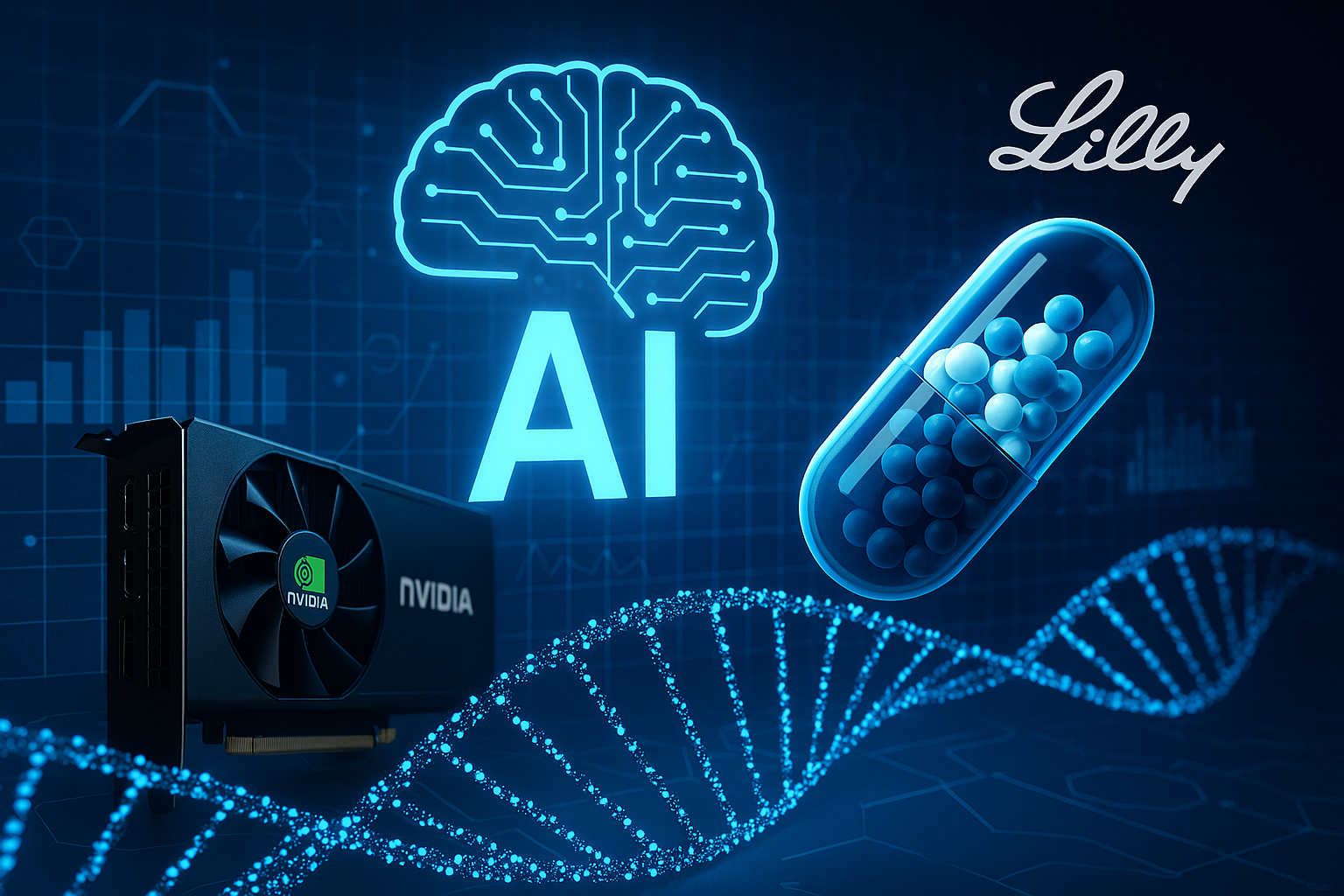
Recent reports show that Nvidia has formed a new partnership with Eli Lilly, one of the largest drug makers in the United States. The two companies agreed to build what they describe as the world’s most powerful pharma supercomputer. They plan to bring it online this January. The system will support drug discovery and development.
Drug companies are shifting toward computer‑based research models. They now test chemical and biological data through software before moving to lab trials. AI plays a growing role in this shift. Many researchers believe AI will spark a major change in how new medicines are found.
AI systems can combine chemical and biological data in one place and run fast analysis. Several companies have already started this work. Early results suggest AI can shorten the time needed to find new drug candidates and reduce costs. Some experts say it may also open the door to new discoveries that were not possible before.
Insilico Medicine, another US‑based company, has used AI in drug development since 2019. The company says it is working on 40 drug programs supported by AI. It reports that pre‑trial work that once took up to five years now finishes in about 18 months.
Drug development remains slow and expensive. Only a small share of drug candidates reach human trials, and about 90 percent fail during testing. This high failure rate pushes the cost of a successful drug to nearly $3 billion. Early studies show AI may help reduce this failure rate.
The preclinical phase, which comes before human testing, usually takes three to five years. AI tools have cut this period to 12 to 18 months in some cases. Success rates have also improved. Lower costs may follow. Because of this, analysts expect more investment in AI across the pharmaceutical industry.
Drug design often begins with tests on small biological molecules. AI can scan billions of molecules at once. Software can test their strength, solubility, and toxicity. Researchers say AI is improving the testing process as well.
AI use in drug development is still in the trial stage. Drug companies and AI firms depend on each other because AI systems need large amounts of biological data. Many in the industry believe these new methods will become standard within a few years.
AI also raises hopes for faster solutions to long‑standing medical problems. It may help make some medicines more accessible, especially in low‑income countries where many drugs remain out of reach until generic versions appear.
